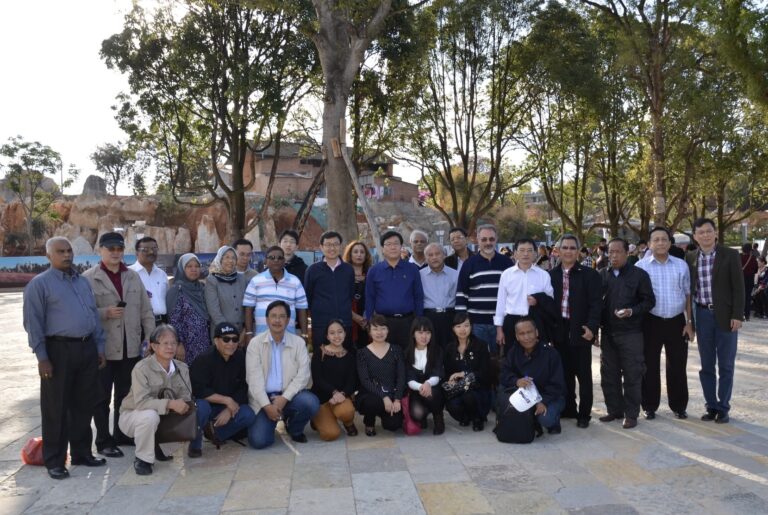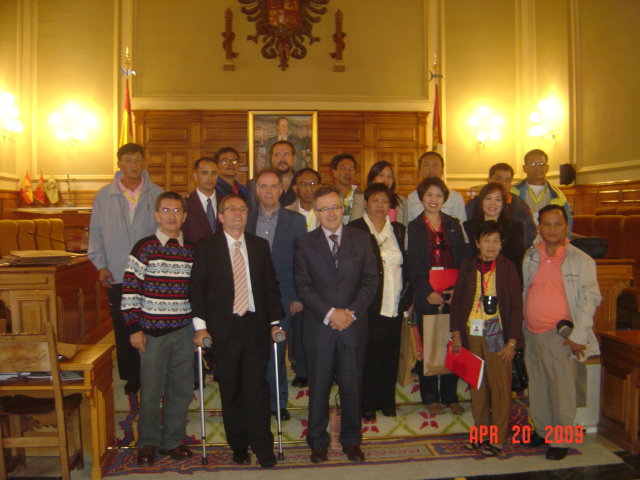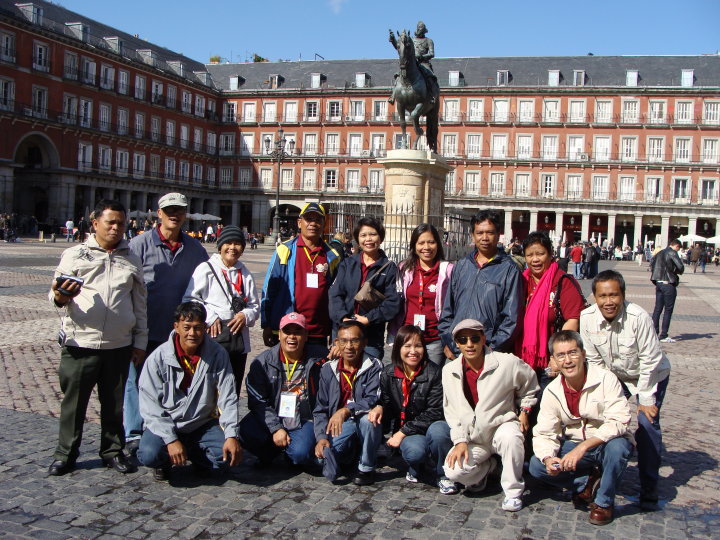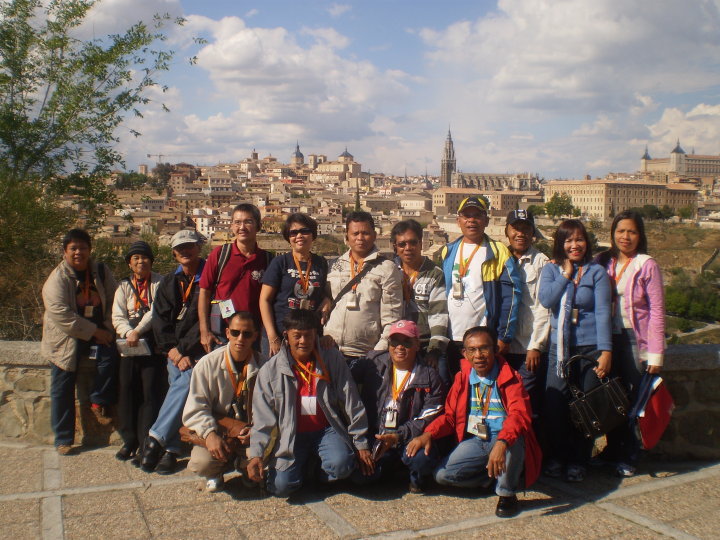
A pose for posterity at the city of Toledo, which is the capital of the Autonomous Region of Castella La Mancha, Spain by the 15-man Philippine Delegation to the Study Visit on the Development of Cooperative Integration in Spain on April 18-26, 2009. Standing from left to right are: Aloha Gigi Banaria, Caridad Vargas, Ernesto Parato, Nielo Tingson, Isabelita Ocampo, Almar Autida, Reynaldo Rosales, Antonio Betasolo, Edelito Sangco, Luz Brenda Balebria, and Jodel Tabada. Seated from left to right are: Alvin Paul Dirain, Jerry Mercado, Mario Esposo, and Levi Sta. Maria, Sr.
I. RATIONALE:
Agriculture and agribusiness remain to be the backbone of the Philippine economy. To support the development of the sector, the Philippine Government through the Department of Agriculture (DA) has availed of a grant assistance from the Government of Spain through the Agencia Española de Cooperacion International para el Desarollo (AECID) to implement the “STRENGTHENING OF THE AGRO-INDUSTRIAL SECTOR IN BICOL AND CARAGA (SAIS-BC) PROJECT.” Bicol and Caraga, being identified as among the poorest regions in the country, are the geographical focus of the 5th RP-Spain Joint Commission for Cooperation
SAIS-BC is a 3-year project which aims to support the current thrust of DA on agribusiness development in order to generate jobs. It focuses on value-adding of major commodities such as coconut, abaca,cassava and pineapple. The project provides funds for the establishment of processing facilities and installation of the required machineries and equipment, conduct of training for both beneficiaries and project implementers to facilitate the smooth implementation of project activities and sustain the benefits that will be gained from the project, and for the creation and strengthening of the marketing network of the processed products. A Technical Assistance (TA) on cooperative development and integration is also provided under the project.
To facilitate proper management and sustainable operation of the established processing facilities, the project works with cooperatives and farmers’ organizations in cooperation with the concerned localgovernment units of the selected project areas. Strong cooperative sector is believed to be important for the repercussions it represents both in increasing productivity and profitability of agricultural operations, and in increasing efficiency of the marketing channels of agricultural and food products, hence, promoting sustainable rural and agricultural development.
Cooperatives are the public sector’s partners in supporting the small farmers. A strong cooperative organization can greatly contribute in the implementation of agricultural policies. A strong cooperative foundation is the best guarantee for a sustainable agricultural and rural development.
Noting these potentials, the SAIS-BC Project was designed to support the cooperatives, thereby promoting integration and strengthening of cooperatives in Bicol and Caraga regions. However, majority of the agri-based cooperatives in the Philippines are still weak. As such, promotion and strengthening of the cooperative sector is given utmost importance under the SAIS-BC project.
Thus, under the Spanish Technical Assistance on Cooperative Integration of the project, a study trip to successful cooperatives in Spain was recommended to promote cooperative integration. Spain is one ofthe few countries with very successful cooperative movement.
Cooperatives are the building blocks of Spain’s agriculture sector and rural development. Hence, the study trip to Spain was conducted on April 18-26, 2009.
II. GOAL AND OBJECTIVES:
Generally, the study trip aimed to enhance the capacities of the SAIS-BC project implementers and partner cooperatives to smoothly implement and sustain the project activities.
Specifically, it aimed to:
- Learn from the experiences of the successful cooperatives in Spain on cooperative development in order to increase the level of consciousness of the project implementers and partner cooperatives on the advantages of cooperative integration;
- Increase the level of consciousness of the project implementers and partner cooperatives/farmers’ association on the advantages of cooperative integration to encourage them to apply the principles and mechanisms of cooperative integration;
- Strengthen the capacities of the selected LGU personnel to promote local initiatives, adopt extension functions, and consider the whole dimension of rural development; and
- Prepare the participants to adapt to changing conditions in the market as well as in social and political environment.
III. PARTICIPANTS:
The study trip was participated in by selected representatives from the Central PCO, Sub- PCO in Bicol and Caraga and from the selected partner LGUs and beneficiary cooperatives. AECID-Caraga also sent one representative to the study trip. Following are the list of participants:
- Central Project Coordination Office, DA-PDS
Ms. LUZ BRENDA P. BALIBREA – Training & Caraga Area Coordinator Mr. ALVIN PAUL J. DIRAIN – M&E and Bicol Area Coordinator
- Bicol Sub-Project Coordination Office, DA-RFU V
Mr. ERNESTO N. PARATO – Sub PCO Coordinator Ms. ALOHA GIGII. BAÑARIA – Training Coordinator
- Caraga Sub-Project Coordination Office, DA-RFU XIII
Ms. JODEL A. TABADA – Assistant Sub PCO Coordinator Ms. ISABELITA L. OCAMPO – Training Coordinator
- Partner LGU Focal Persons
Mr. JERRY M. MERCADO – Goa, Camarines Sur
Mr. REYNALDO A. ROSALES – Butuan City, Agusan del Norte
Mr. ALMAR B. AUTIDA – Bislig City, Surigao del Sur
- Chairpersons of Partner Cooperatives
Mrs. CARIDAD V. VARGAS – Macutal Farmer-Producers Cooperative (MFPC), Bicol Region
Mr. LEVI T. STA. ANA, SR. – Liga ng mga Barangay Multi-Purpose Cooperative (LBMPC), Bicol Region
Mr. MARIO M. ESPESO – Labo Progressive Multi-Purpose Cooperative (LPMPC), Bicol Region
Mr. ANTONIO O. BETASOLO – Manila de Bugabus Multi-Purpose Cooperative (MBMPC), Caraga Region
Mr. EDELITO C. SANGCO – Socorro Empowered People’s Cooperative (SOEMCO), Caraga Region
- Agencia Espanola de Cooperacion Internacional para el Desarollo
Mr. NIELO L. TINGZON – Regional Technical Director, AECID-Caraga
IV. TRAINING PROGRAM MECHANICS:
The study program was a 9-day activity. The itinerary includes visits to different types of integrated cooperatives existing in the autonomous regions of Castilla La Mancha (CLM) and Valencia and in selected government offices concerned in supporting cooperative development in Spain.
The study-visit includes lectures, site visits, interaction with farmers and cooperative leaders, and some hands-on training activities. Conduct of the study visit was coordinated by the TA Project Coordinators: Mr. Juan Sebastian Castillo Valero, Mr. Jose Maria Garcia Alvarez-Coque and Mr. Jose Luis Collado together with the very active and supportive TA Team members: Ms. Katia Oceransky, Mr. Antonio Jimenez, Atty. Rodolfo Clari-clari and Mr. Antonio Aznar. Each visit was accompanied by the most appropriate professor of practice in accordance with the subject to be tackled in the visit. Ms. Katia Oceransky acted as the interpreter and tour guide during the entire study-visit that greatly facilitated the smooth communication flow and group interaction.
The group stayed in Toledo for two days and one night, two days and two nights in Albacete. The group also stayed for two days and two nights in Valencia before going back to Madrid where the group spent the last night of the Study Trip in Spain.